
Views: 0 Author: Site Editor Publish Time: 2026-07-02 Origin: Site


Chronic musculoskeletal pain often forces a difficult choice between temporary symptom relief and invasive procedures. Patients frequently cycle through steroid injections or pain medication before reluctantly considering surgery. You deserve better options for true tissue recovery.
Extracorporeal Shockwave Therapy has emerged as an evidence-based, non-invasive alternative to surgery. However, varying equipment standards and bold clinical claims make evaluation difficult for patients and practitioners alike. Understanding the underlying science is essential for making informed treatment decisions.
This guide cuts through the marketing noise to examine clinical realities and implementation risks. We will explore practical criteria for determining if this modality aligns well to achieve your recovery or clinical goals. You will learn exactly how to evaluate the technology and the providers behind it.
Shockwave therapy utilizes targeted acoustic waves to stimulate cellular metabolism and neovascularization, primarily benefiting chronic tendinopathies and calcific conditions.
Clinical outcomes depend heavily on proper patient selection; it is not a universally applicable treatment for all musculoskeletal pain.
Equipment quality matters significantly: distinguishing between radial and focused shockwave devices is critical for matching treatment to tissue depth.
Evaluating a provider or a Shockwave Therapy supplier requires looking past surface claims to verify FDA clearance, practitioner credentialing, and realistic treatment protocols.
Standard conservative treatments often fail when tissue healing stagnates. Tendons and ligaments possess poor blood supply naturally. Once they sustain chronic damage, they often enter a state of failed healing. Scar tissue builds up. Cellular metabolism slows down. Rest and ice cannot fix this biological roadblock. Practitioners need a catalyst to restart this stalled healing cascade. Acoustic energy provides this exact mechanical trigger.
Therapeutic shockwaves are high-energy acoustic pulses. They travel rapidly through soft tissues. These are not electrical shocks. They are sound waves carrying specific physical energy. When these waves hit dense scar tissue or calcifications, they create controlled micro-trauma. This intentional micro-trauma tricks your nervous system. Your body perceives a new injury. It immediately rushes fresh blood and growth factors to the area. This process triggers neovascularization, meaning your body builds brand-new blood vessels. More blood means more oxygen. More oxygen means faster cellular repair.
Not all acoustic waves behave similarly in clinical applications. You must understand the difference between radial and focused energy delivery. This distinction dictates treatment success.
Shockwave Modality Comparison Chart
Feature | Radial Shockwave (rESWT) | Focused Shockwave (fESWT) |
|---|---|---|
Energy Delivery | Spreads outward in a cone shape. | Converges tightly at a specific target. |
Penetration Depth | Shallower (approx. 3-4 cm). | Deeper (up to 12 cm). |
Ideal Indications | Achilles tendon, large muscle groups, fascia. | Deep joint issues, bone healing, calcifications. |
Sensation | Feels like a localized, intense percussion. | Feels like a deep, precise dull ache inside the tissue. |
Major medical institutions recognize these biological mechanisms. Clinical guidelines from organizations like the Mayo Clinic validate extracorporeal acoustic wave applications. Extensive literature across the NCBI databases supports its efficacy. However, credible sources avoid anecdotal "miracle cure" language. The science relies entirely on biological remodeling. Tendons take time to rebuild their collagen matrix. The acoustic waves simply start the construction process.
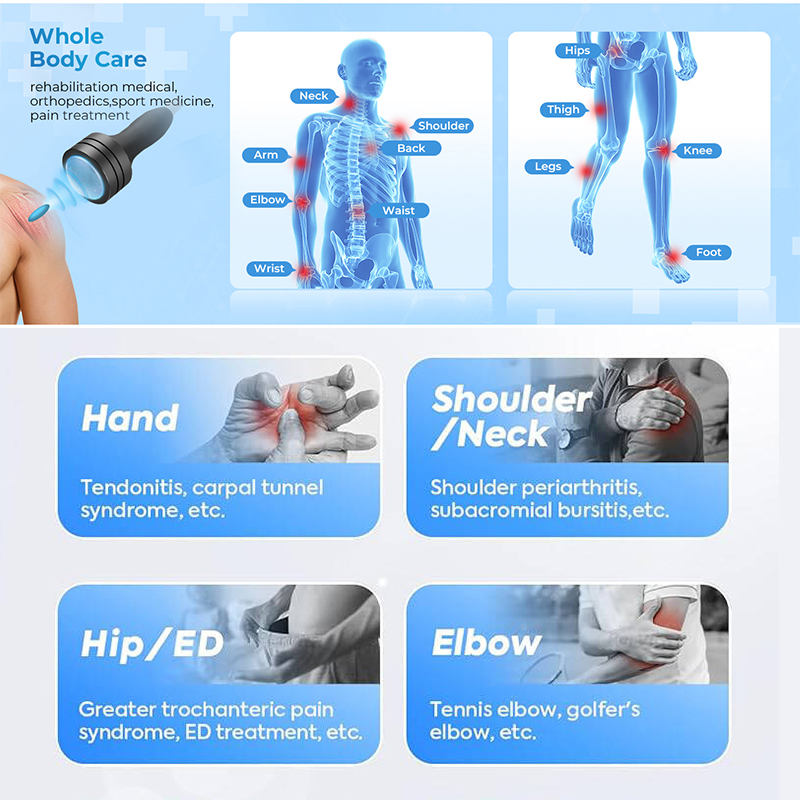
Clinical outcomes depend heavily on accurate patient selection. You cannot apply this modality randomly to every aching joint. Medical providers must define specific success criteria before beginning. True success looks like a progressive reduction in pain scores over 12 weeks. It rarely provides instant, permanent relief on day one. Your tissue requires a physical remodeling phase.
Certain conditions respond exceptionally well to acoustic wave intervention. Orthopedic specialists refer to these as high-conviction indications. Patients suffering from these specific ailments represent the most ideal candidates for intervention.
Plantar Fasciitis: This therapy excels in chronic cases lasting longer than six months. When cortisone injections fail, acoustic waves often succeed in breaking down fibrotic fascia tissue.
Calcific Tendonitis of the Shoulder: Calcium deposits restrict rotator cuff movement. Focused shockwaves physically disrupt these hard calcifications. Your body then naturally absorbs the broken-down calcium over time.
Tennis Elbow (Lateral Epicondylitis): Chronic gripping micro-tears the common extensor tendon. Acoustic energy stimulates robust collagen production to repair these stubborn micro-tears.
Achilles and Patellar Tendinopathy: Large, load-bearing tendons lose elasticity over time. Treatment restores necessary blood flow to these notoriously avascular regions.
Conversely, strong safety boundaries exist. Certain populations must avoid acoustic wave treatments entirely. Exposing the wrong patient to high-energy pulses carries unnecessary risks.
Pregnancy: Practitioners must never apply acoustic waves near the abdomen or lower back of a pregnant patient.
Active Infections: Treating over an infected area can spread bacteria through increased local blood flow.
Peripheral Vascular Disease: Fragile blood vessels cannot withstand the mechanical stress of high-energy acoustic pulses.
Targeted Anatomical Risks: Technicians must never direct acoustic waves over lung tissue, major nerve bundles, or the brain.
Every medical intervention presents a balance of advantages and limitations. Understanding these realities prevents frustration and ensures you complete the full clinical protocol.
The advantages appeal strongly to patients seeking conservative care. The procedure remains entirely non-surgical. You require zero anesthesia. You walk into the clinic and walk out independently. Patient compliance rates stay remarkably high. Furthermore, the protocol eliminates medication dependency. You avoid the systemic side effects of prolonged NSAID use or opioid prescriptions.
However, you must acknowledge the limitations. The application causes localized discomfort. As the acoustic waves penetrate scarred tissue, you will feel a distinct ache. Furthermore, you face a delayed onset of definitive results. Because we rely on cellular remodeling, the true structural repair takes months. Additionally, you will likely encounter a lack of universal insurance coverage. Many major carriers still classify this specific modality as investigational for certain joint applications.
Understanding the rollout phase helps manage daily expectations. Most clinics utilize a highly standardized approach for chronic tendinopathies.
Initial Mapping: The practitioner palpates the area or uses diagnostic ultrasound to pinpoint the exact site of maximal pain.
Gel Application: They apply a conductive gel to your skin. This ensures the sound waves travel efficiently into the body without losing energy in the air.
Energy Delivery: The technician administers 2,000 to 3,000 individual pulses over a span of five to ten minutes.
Session Spacing: You will typically undergo 3 to 6 total sessions. Clinics schedule these appointments 5 to 7 days apart.
You must prepare for the post-treatment "soreness" factor. Temporary inflammation is an expected outcome. In fact, it is a necessary part of the healing protocol. Practitioners advise against taking anti-inflammatory medications (like Ibuprofen) immediately following a session. These drugs blunt the exact inflammatory response we just worked hard to create.
Mitigating long-term risks requires active participation. You cannot treat extracorporeal energy as a standalone passive treatment. You must combine it with physical therapy loading protocols. Eccentric strengthening exercises organize the new collagen fibers generated by the acoustic waves. Mechanical stimulation plus mechanical loading yields the highest success rates.
The effectiveness of your therapy is directly tied to the technology used. The market is flooded with inexpensive percussion devices masquerading as clinical equipment. A massage gun provides pleasant muscular relief. It does not deliver true clinical shockwaves. You must evaluate the hardware rigorously.
When you interview prospective providers or clinics, ask highly specific questions. Inquire whether they use focused or radial technology. Their answer should match your diagnosis. Deep hip pain requires focused waves. Superficial Achilles pain responds beautifully to radial waves. Ask if their machines are FDA-cleared for your specific musculoskeletal indication. Reputable clinics proudly discuss their equipment specifications.
For clinical buyers or practice owners, evaluating a Shockwave Therapy supplier requires deep technical due diligence. Surface-level marketing brochures often hide inferior internal components. You must examine the technical specifications closely. Look at the bar pressure range. High-quality radial devices should comfortably reach 4.0 to 5.0 bar. Check the frequency controls. You need versatile Hz settings to manage patient comfort during the initial pulses. Evaluate the energy flux density (mJ/mm2) for focused units. This metric determines the true cellular impact depth.
Beyond specifications, analyze the training and support infrastructure. Does the supplier provide comprehensive clinical implementation training? Merely dropping off the hardware guarantees poor patient outcomes. Your staff needs hands-on instruction regarding exact anatomical targeting and energy ramping protocols.
Finally, scrutinize maintenance and scalability. Compressors wear out. Handpieces require scheduled revisions after a million pulses. Review the warranties carefully. Ask about the revision lifecycle of the bullet and tube within the radial handpiece. Ensure the supplier provides immediate compliance documentation for your local health regulators. A reliable supplier acts as a long-term clinical partner, not a one-time vendor.
Making a final decision requires a logical framework. You must weigh the out-of-pocket cost of the treatment packages against the physical toll of alternative paths. Prolonged chronic pain degrades your daily movement mechanics. It forces compensatory movement patterns. These bad habits often lead to secondary injuries in neighboring joints. Alternatively, surgical recovery involves extensive downtime, rehabilitation costs, and inherent operative risks.
When you map these factors, a multi-session conservative approach often proves highly favorable. It allows you to maintain your daily work schedule. You avoid the catastrophic downtime associated with tendon repairs. You simply trade a short window of localized discomfort for a high probability of tissue regeneration.
Your most actionable next step involves securing proper imaging. We strongly recommend booking a diagnostic ultrasound or an initial clinical consultation. Do this before committing to a multi-session financial package. A skilled practitioner must confirm tissue suitability. They need to visualize the tendon thickness, identify specific calcifications, and rule out complete ruptures. Once imaging confirms a chronic, non-ruptured tendinopathy, you can proceed with confidence.
Extracorporeal acoustic wave application stands out as a highly effective, evidence-backed tool for chronic musculoskeletal conditions. It bridges the frustrating gap between temporary pain relief and invasive surgical intervention. By intentionally restarting your body's stalled biological healing cascade, it offers a genuine path toward structural tissue repair.
However, its overall success relies strictly on accurate diagnosis, targeted technology, and carefully managed expectations. You must match the specific modality—radial or focused—to your unique anatomical needs. Furthermore, you must commit to the required biological timeline. Tendon remodeling requires patience, consistent sessions, and appropriate physical therapy loading.
We encourage you to take proactive steps today. Consult a certified orthopedic specialist or physical therapist to discuss your stubborn joint pain. Use the criteria outlined in this guide to carefully vet your prospective clinic or equipment supplier. Armed with this knowledge, you can confidently pursue true physiological recovery.
A: It causes mild, tolerable discomfort rather than severe pain. You will feel a deep, pulsing ache as the acoustic waves hit damaged tissue. The technician can easily adjust the machine's energy output based on your real-time feedback. Most patients find the sensation entirely manageable for the short five-minute duration.
A: You must manage your timeline expectations carefully. While some patients experience an initial decrease in pain due to nerve overstimulation, true healing takes longer. Physiological tissue remodeling requires 8 to 12 weeks. You will notice the most significant functional improvements two to three months after completing your final session.
A: It remains largely an out-of-pocket expense in many regions. Most major insurance carriers still classify it as investigational for general musculoskeletal pain. However, you can typically use Flexible Spending Accounts (FSA) or Health Savings Accounts (HSA) to cover the costs. Always ask your clinic for specific coding nuances.
A: Yes, physical therapists frequently administer these treatments. However, regional compliance and scope of practice laws vary by state or country. In many jurisdictions, trained physical therapists, chiropractors, and podiatrists legally integrate acoustic wave devices into their daily rehabilitation programs to accelerate patient recovery.


