
Views: 0 Author: Site Editor Publish Time: 2026-06-16 Origin: Site


Integrating a new therapeutic device demands rigorous clinical justification. You need evidence-backed reasons before committing your clinic's resources. We know you already understand the foundational science behind these treatments. Yet, navigating conflicting vendor claims feels overwhelming. Proprietary metrics and varying capabilities complicate the evaluation process. You might find it difficult to separate true clinical value from marketing hype. We will introduce a structured, evidence-oriented framework to help you evaluate these machines. You will learn to assess verifiable technical specifications accurately. We will show you how to match device capabilities directly to your clinical applications. You will also discover how to evaluate manufacturer reliability. This ensures long-term operational success. By the end, you will confidently navigate the procurement process.
Clinical efficacy depends heavily on verifiable energy flux density (mJ/mm²) and penetration depth, not just marketing terminology.
Selecting the right device requires matching the focal zone capabilities to your primary clinical specialty (e.g., deep tissue orthopedics vs. urology).
Total Cost of Ownership (TCO) extends far beyond the sticker price; applicator lifespan and maintenance contracts define long-term profitability.
Partnering with a compliant, transparent focused shockwave therapy manufacturer mitigates implementation risks and ensures consistent clinical training.
Energy Flux Density dictates the actual therapeutic power delivered to the tissue. You measure this power in millijoules per square millimeter (mJ/mm²). Different pathologies require distinct therapeutic ranges. Low-energy treatments usually fall between 0.01 and 0.08 mJ/mm². You use low energy primarily for pain management and cellular stimulation. Medium-energy ranges from 0.08 to 0.28 mJ/mm². This range effectively treats tendon disorders and mild calcifications. High-energy treatments exceed 0.28 mJ/mm². You rely on high energy for severe calcific tendinopathy and bone non-unions.
Watch out for misleading marketing terminology. Some vendors obscure true EFD metrics. They might conflate radial pressure waves with true focused shockwaves. A genuine focused shockwave therapy device concentrates energy at a specific internal point. Radial devices disperse energy superficially. Always demand exact EFD charts from the vendor to verify clinical capabilities.
Next, evaluate the penetration depth and focal zone volume. The focal zone is the three-dimensional area where the energy reaches therapeutic levels. True focused devices can reach depths up to 12.5 cm. This depth is critical for treating deep-seated hip or shoulder pathologies effectively.
Assess the availability of stand-offs. Stand-offs are specialized gel pads attached to the applicator head. They allow you to precisely adjust the depth of the focal zone. You use thicker stand-offs for superficial targets. You remove them entirely for maximum penetration. A versatile machine must include multiple stand-off sizes to accommodate diverse patient anatomies.
Manufacturers use three primary methods to generate acoustic waves. Electrohydraulic generation relies on a high-voltage spark inside a water-filled applicator. This creates a plasma bubble that expands and collapses instantly. This method produces a very fast rise time and high peak energy. Electromagnetic generation uses a cylindrical or flat coil. Passing an electrical current through the coil creates a strong magnetic field. An acoustic lens then focuses this wave into a specific zone. Piezoelectric generation involves hundreds of piezoceramic crystals arranged inside a spherical dish. Applying a high-voltage pulse makes these crystals expand and contract simultaneously. This provides an incredibly precise, narrow focal zone.
Focus your decision lens on operational longevity. Each generation method impacts internal component wear differently. Consider how often you will need to replace parts and how that affects daily clinical operations.
Generation Technology | Mechanism of Action | Focal Zone Characteristics | Operational Consideration |
|---|---|---|---|
Electrohydraulic | High-voltage spark in water | Large focal volume, high peak energy | Spark plugs require regular replacement |
Electromagnetic | Magnetic field repels a membrane | Consistent, stable focal zone | Coils generally offer a longer lifespan |
Piezoelectric | Expanding piezoceramic crystals | Highly precise, narrow focal zone | Operates quietly with minimal maintenance |
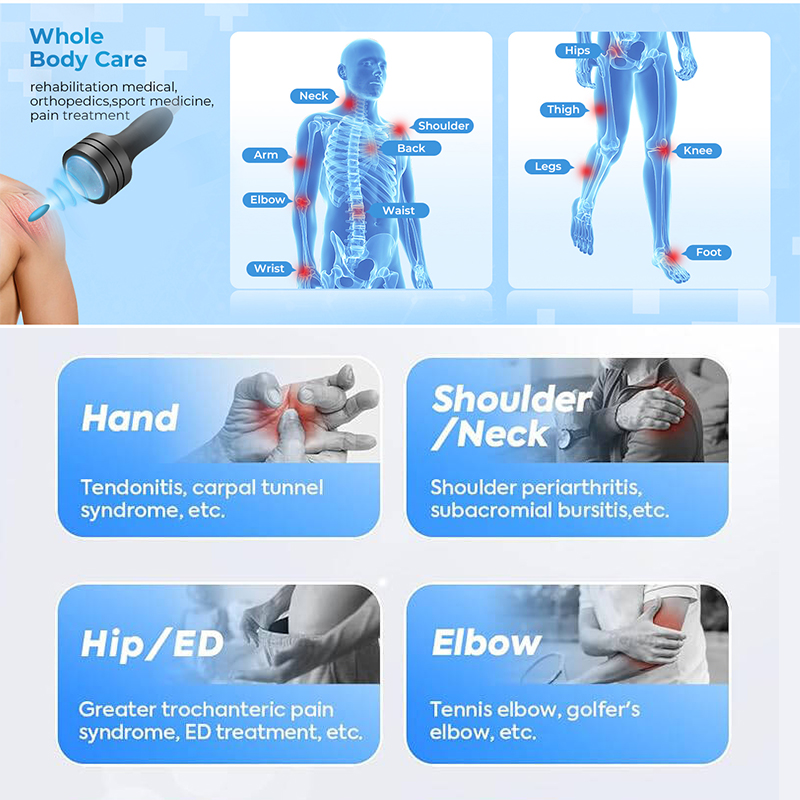
Orthopedic clinics demand robust treatment capabilities. Your success criteria hinge on high energy output and deep tissue penetration. Athletes often present with chronic, deep-seated issues. You need a device capable of reaching calcific tendinopathy in the rotator cuff. You also need sufficient power to stimulate bone healing in non-unions. High-energy focal zones create powerful cavitation bubbles. These bubbles collapse and trigger neovascularization. This biological process is absolutely essential for resolving chronic sports injuries.
Urology requires an entirely different technical approach. Treatments for erectile dysfunction or Peyronie’s disease rely on low-intensity extracorporeal shockwave therapy (Li-ESWT). Your success criteria focus heavily on precision and low-energy distribution. You must avoid collateral tissue damage in highly sensitive anatomical areas.
Look for devices offering specific linear focal zones.
A linear focal zone covers the anatomical structure more evenly.
This reduces overall treatment time significantly.
It greatly improves patient comfort during the procedure.
Physiotherapy and chiropractic clinics benefit immensely from hybrid integration. You likely already use radial devices for myofascial release. Your success criteria involve balancing ease of use with machine portability. A compact machine allows you to move between treatment rooms easily. You can design comprehensive treatment protocols for complex cases. You might use radial waves to loosen superficial fascia first. Then, you apply focused waves to target a specific tendinopathy deep within the joint.
Regulatory compliance is your first non-negotiable filter. You must verify FDA clearance for United States markets. For European markets, demand proof of current CE or MDR marks. A trustworthy focused shockwave therapy manufacturer acts transparently. They will clearly share their exact cleared indications for use. They never encourage off-label marketing claims. You protect your clinic from severe liability by verifying these certifications directly.
Clinical training and implementation support matter immensely. High-energy focused shockwaves carry a steep learning curve. Misusing a focused device poses a higher risk of adverse effects compared to radial therapy. You could inadvertently cause nerve damage or severe bruising if poorly trained. Assess the depth of the manufacturer's onboarding program. Do they provide on-site clinical training for your staff? Do they offer access to peer-reviewed treatment protocols? Superior manufacturers supply ongoing education to keep your clinical team updated on best practices.
Evaluate the warranty and maintenance terms carefully. Review the Service Level Agreements in detail. High-end medical devices require regular calibration and maintenance. Ask manufacturers about their specific downtime mitigation strategies. Do they offer loaner programs during repairs? A broken machine halts patient treatments immediately. This damages your clinic's reputation and frustrates patients. A strong manufacturer support network ensures your practice runs smoothly without unexpected interruptions.
Step 1: Define Clinical Non-Negotiables: Document the exact penetration depths required for your top three patient demographics. Document the necessary energy levels. If you treat mostly superficial sports injuries, prioritize adjustable stand-offs. If you treat deep bone non-unions, prioritize maximum EFD. This list becomes your objective scoring rubric.
Step 2: Compare Operational Longevity: Evaluate the expected lifespan of the applicator head. Understand the replacement frequency for internal components. Request explicit, written data on consumable lifespans from at least three different vendors. Compare how often you will need to replace a spark plug versus a piezoelectric crystal. These operational metrics dictate your long-term maintenance schedule.
Step 3: In-Clinic Demos: Never buy a machine based on a trade show demonstration alone. Trade shows lack real-world clinical pressure. Insist on an in-clinic trial period. Test the ergonomics of the applicator on actual patients. Heavy applicators cause rapid operator fatigue. Evaluate the machine's cooling system under continuous patient volume. Some devices overheat and shut down after consecutive treatments. An in-clinic demo reveals these hidden operational flaws immediately.
Choosing the right machine is a delicate balancing act. You must verify technical specifications against your actual clinical needs. You must align the device capabilities with your specific medical specialty. You must also calculate the long-term operational longevity of the system. Remember that the physical device is only part of the equation.
The machine is only as good as the clinical training and ongoing support behind it. Choose a reliable focused shockwave therapy manufacturer to ensure consistent patient outcomes. Encourage your clinic managers to audit current patient demographics today. Build your technical requirement list based on actual clinical data. Then, request specific operational longevity data from your shortlisted vendors to make a confident, informed decision.
A: They use different operational models. Radial devices rely on a physical projectile striking a transmitter. You regularly replace these projectiles and tubes. Focused devices use high-voltage generators or piezoelectric crystals. They require less frequent part changes but involve entirely different internal acoustic mechanisms.
A: Applicator lifespan varies by the underlying generation technology. Most reliable applicators provide between 1 million and 5 million shocks. Electrohydraulic spark plugs often need replacement sooner than electromagnetic coils. Always request these specific lifespan metrics in writing before finalizing procurement.
A: Regulations vary significantly by jurisdiction. Certain generation methods, like electrohydraulic systems, often require a licensed physician for operation. Other technologies might allow physiotherapists or chiropractors to administer treatment under specific guidelines. Always confirm local regulatory compliance before integrating these devices.
A: No, they act as complementary tools. You use a focused shockwave therapy device for deep, precise pathologies. It targets specific cellular structures without affecting surrounding tissues. You use a radial device for broad, superficial myofascial work. Many successful clinics integrate both.


